
|


INTRODUCTION I. Nature's Own Time-Management Tool II. The Pattern of the Lunation Cycle THE WAXING PHASES STEP ONE The New Moon STEP TWO The Crescent Moon STEP THREE The First-Quarter Moon STEP FOUR The Gibbous Moon WANING PHASES STEP FIVE The Full Moon STEP SIX The Disseminating Moon STEP SEVEN The Third-Quarter Moon STEP EIGHT The Balsamic Moon APPENDIX What About Void-of-Course Moon  A HANDBOOK FOR THE HUMANISTIC ASTROLOGER The Complete Guide to Understanding Your Birth Chart
Now available in
Paperback and eBook Formats |

The cyclic relationship between the Sun and Moon — and between any two astrological planets — is constantly changing, never static. All cycles of planetary relationship begin and end with the conjunction aspect, an angular relationship of zero degrees. A cycle is not a circuit of empty and meaningless "eternal return," but a spiralic process of evolutionary growth, so two successive conjunctions never occur at the same place. The Lunation Cycle has two fundamental half-cycles or hemicycles. The character of the first or waxing hemicycle, from New Moon (conjunction to Full Moon (opposition), is of decidedly different character than the waning hemicycle extending from the Full Moon to the next New Moon. . . . 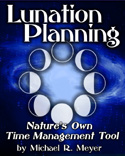 Read more and purchase the Kindle eBook at Amazon.com Don't Have a Kindle? No problem! Download a free Kindle app for PC, MAC, Nook, iPad, iPhone, Tablets and Android devices at Amazon.com

Copyright © 2003 by Michael R. Meyer.
All Rights Reserved.  mail@khaldea.com Web design and all data, text and graphics appearing on this site are protected by US and International Copyright and are not to be reproduced, distributed, circulated, offered for sale, or given away, in any form, by any means, electronic or conventional. Unless otherwise noted, all text, data and graphics appearing on this site are copyright © 2000-2010 by Michael R. Meyer. All Rights Reserved. See Notices for copyright statement, conditions of use, and disclaimer. |About|Calendar|Ephemeris| |Charts|Art Gallery|Library|Resources| |Shop|Links|Rudhyar Archival Project|Help| Web design and programming for this entire site copyright © 2000-2004 by Michael R. Meyer. |